
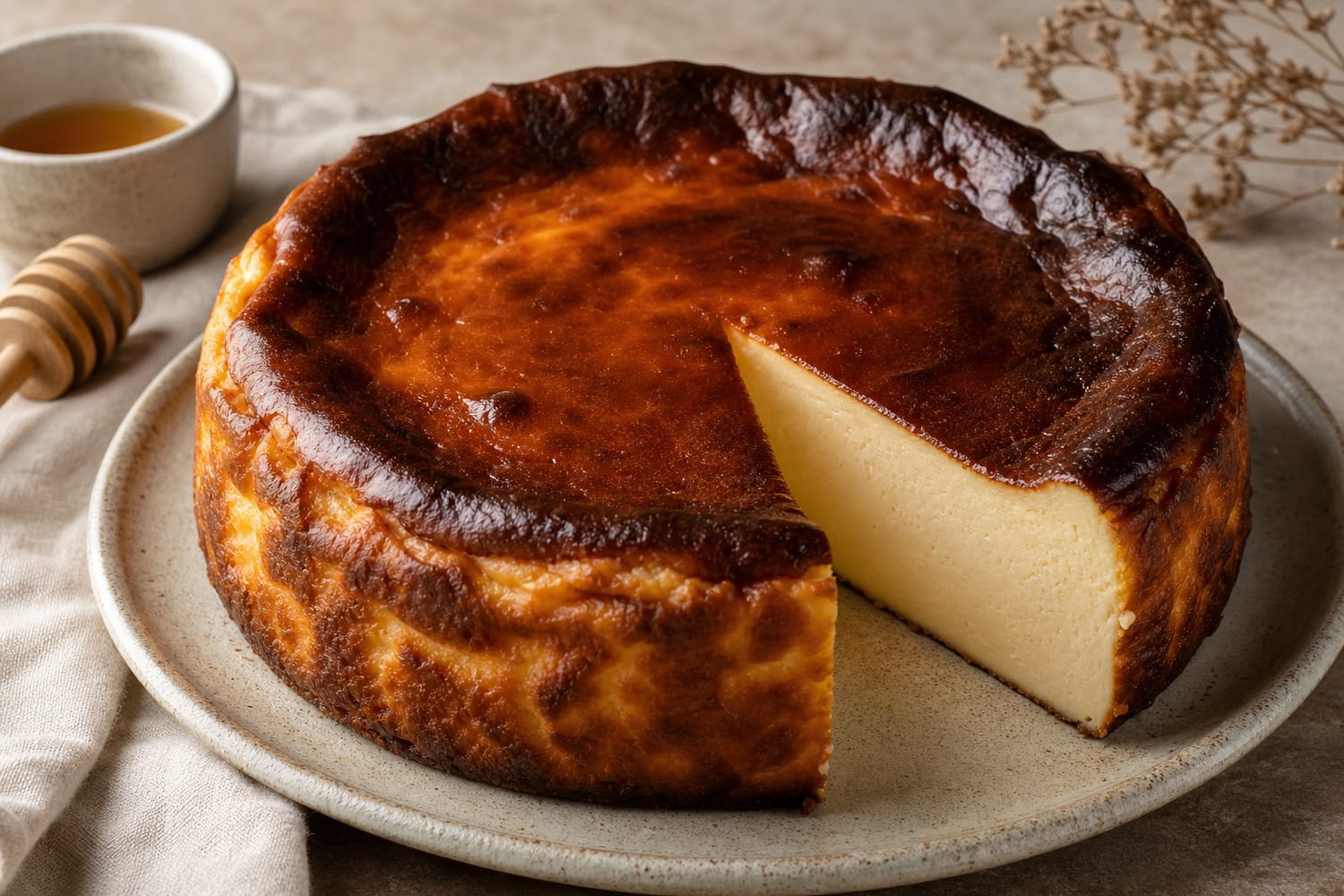
Basque-style burnt cheesecake is known for rejecting many of conventional cheesecake’s rules. There is no crumb crust, no water bath, and no attempt to preserve a pale, perfectly smooth surface. Instead, high heat produces a dramatically bronzed exterior while the middle remains creamy and almost custard-like. The dessert became famous through La Viña, a family-run bar in San Sebastián, Spain, where Santi Rivera developed the original version during the late 1980s. National Geographic’s history of Basque burnt cheesecake offers a closer look at its origins and worldwide popularity.
This Neural Burnt Honey Basque Cheesecake keeps that recognizable contrast but gives its flavor profile several interconnected “layers.” Heating the honey until dark amber reduces its straightforward sweetness and introduces notes reminiscent of toasted caramel, coffee, and butterscotch. White miso reinforces those flavors with subtle salinity and umami, while orange zest supplies enough brightness to cut through the rich cream cheese.
The inspiration was to build flavor like a neural network: each small element—honey, miso, citrus, pepper, and heat—contributes to a more complex final result without overpowering the cheesecake’s essential character.
Freshly ground black pepper may sound unconventional, but the restrained amount does not make the dessert spicy. Instead, it gives the floral honey and orange a warm, aromatic finish. A final pinch of flaky salt sharpens the burnt caramel notes and keeps every bite balanced.
Unlike a classic New York cheesecake, this version should not be firm, dense, or uniformly set. The center will look underbaked when it leaves the oven, but it continues to stabilize as it cools. Chilling overnight delivers neat slices, while a brief rest at room temperature restores the luxurious texture. For another exploration of honey paired with cream cheese, try Iron Chef AI’s Hyperparameter Honeycake.